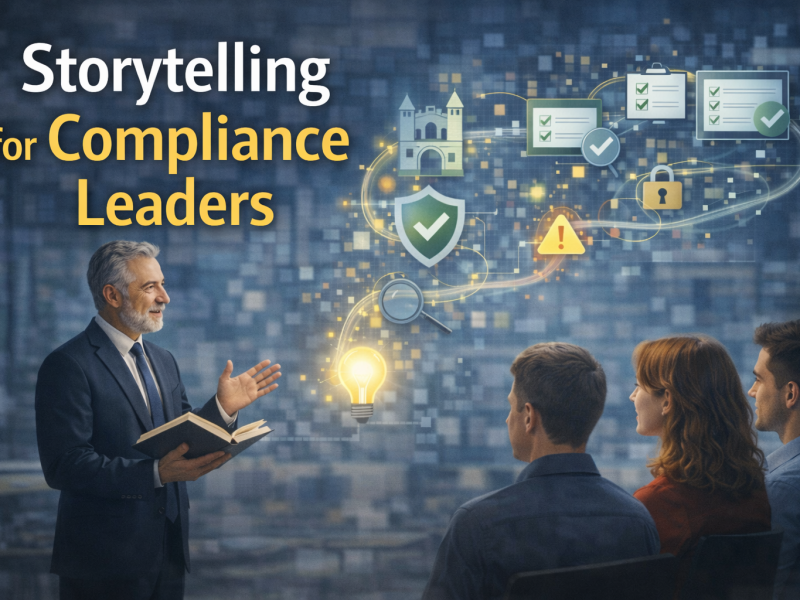




(Because facts inform, but stories make people care.)
You’ve got the facts.
You’ve got the charts, the KPIs, the audit scores.
And yet… every time you speak about compliance, half the room is checking their email.
It’s not that your message isn’t important, it’s that it’s forgettable.
And that’s where storytelling comes in.
Not the fluffy, “marketing” kind.
The kind that turns risk and governance into something people feel, not just read about.
1. Storytelling Isn’t Decoration. It’s Leadership.
Let’s settle this right away:
Storytelling is not theatre.
It’s how leaders translate complex, technical, or boring topics into decisions, emotion, and momentum.
A good compliance leader doesn’t just inform.
They inspire action, confidence, and alignment.
That’s leadership.
Think about it, when you brief the board, do you want them to know you renewed your ISO certification?
Or do you want them to remember how hard your team worked to make it happen?
2. Two Ways to Tell the Same Story
Here’s a practical example.
You could go to your board and say, with the voice of a corporate robot:
“Ladies and gentlemen, following our internal audit and ISO 27001 external audit two months ago, I’m pleased to confirm our certification has been extended for another year with zero non-conformities.”
✅ Clear.
❌ Boring.
Nobody will remember it tomorrow.
Or you could say this instead:
“Last time we met, I’ll be honest, I was worried. The internal audit had revealed a few weaknesses, and our re-certification was coming fast. Yesterday evening, I got the email from the certification body. I read it once. Then twice. And I’ll admit, I almost asked ChatGPT to double-check it for me.
Zero. Non. Conformities.
We passed with a perfect score. The work paid off, and that’s thanks to every one of you.”
Now which version do you think your board will remember next week?
The second one takes the same 45 seconds, but it lands.
3. Why Storytelling Works in GRC
GRC is full of rules, frameworks, and evidence. But stories are what turn all that into meaning.
Here’s why it works:
Stories connect emotions to data. People remember how they felt more than what they heard.
Stories create clarity. Instead of listing controls, you illustrate impact.
Stories build trust. When you speak like a human, people stop seeing you as the compliance cop.
Storytelling isn’t a communication trick, it’s a trust multiplier.
4. How to Build a GRC Story That Sticks
Keep it simple, accessible, and relevant.
No jargon. No acronyms. Just people, context, and consequence.
Here’s a structure that works anywhere, from awareness training to board meetings:
Step | What You Do | Example |
|---|---|---|
| Start from something familiar | “Last quarter, our internal audit showed 12 open issues…” |
| Show risk, doubt, or challenge | “Some of them were critical, and deadlines were tight.” |
| Let people feel uncertainty or relief | “The night before the audit, we were still fixing controls.” |
| Share the outcome | “And this morning, the auditor’s report came in, no non-conformities.” |
| Explain why it matters | “We didn’t just pass an audit. We proved our process works, even under pressure.” |
You’ve just turned a compliance update into a mini success story.
5. Bring the Human Back Into Compliance
Behind every audit finding, every corrective action, every KPI, there’s a human story:
A control owner who caught something early.
A project lead who pushed back on insecure practices.
A team that turned a painful incident into a lesson learned.
When you tell those stories, you remind people that compliance isn’t bureaucracy, it’s collective intelligence.
6. Storytelling Creates Culture
Here’s the real reason this matters: compliance is everyone’s job now.
Cybersecurity, privacy, resilience, they can’t live in a single department anymore.
When you tell stories about wins, lessons, or near misses, you don’t just inform;
you activate people.
You make them see themselves in the story.
That’s how culture grows:
Not through policies.
Through stories people repeat.
7. The Formula for an Effective Compliance Story
When you’re crafting your next message, awareness video, board briefing, or training deck, run it through this filter:
Element | Question to Ask | Why It Matters |
|---|---|---|
Clarity | Is it written in normal human language? | No one remembers jargon. |
Relevance | Does it connect to their daily reality? | “It could happen here” hits harder than “industry trends.” |
Emotion | Does it make them feel something, pride, fear, relief? | Emotion anchors memory. |
Action | Does it lead to a next step? | Storytelling without a takeaway is just noise. |
8. Final Thought: Stories Build Memory. Memory Builds Culture.
The best leaders don’t just deliver compliance, they narrate progress.
They make resilience visible.
They make risk relatable.
They make controls human.
When your story makes people care, they remember the message, and they follow the mission.
So next time you brief the board, skip the bullet points.
Tell them a story worth repeating.
Learn How to Communicate Like a GRC Leader
Cyber Academy teaches more than frameworks, we teach influence.
If you want to make your next audit debrief sound like a story that inspires trust instead of putting people to sleep:
👉 Join one of our next certification cohort or a private coaching 1-1.
Because frameworks keep you compliant, but stories make you remembered.