


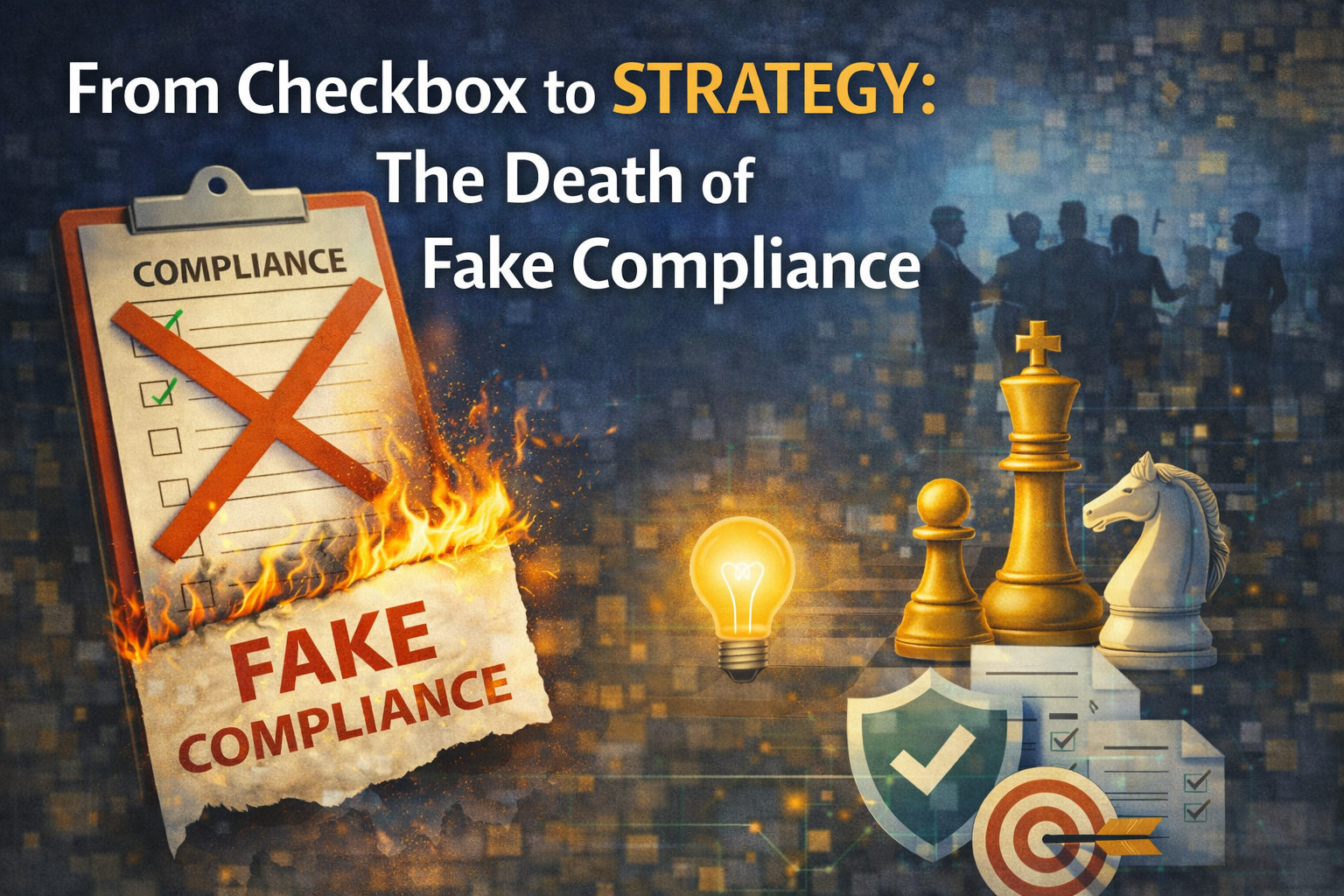
Fake compliance looks good on paper and collapses the moment something goes wrong.
Real compliance protects the business, reduces risk, and earns trust ; but it requires one uncomfortable shift: stopping the checkbox game.
Organisations that stay stuck in “fake compliance” eventually pay for it. The ones who evolve turn security into a strategic advantage.
Let’s be honest: most compliance programmes start as box-ticking exercises.
A policy here, a template there, an annual audit panic, a rushed risk register, and a PDF uploaded to SharePoint.
Auditors hand you a certificate, everyone celebrates, and nothing actually changes.
Then reality hits.
An incident.
A regulator question.
A customer escalates.
And suddenly the “compliance programme” that looked perfect on paper falls apart in minutes.
Field truth:
Fake compliance always breaks the moment it’s tested.
Not because teams are bad ; but because they were trained to optimise for passing, not for operating.
Here’s what organisations must learn if they want to leave checkbox compliance behind.
1. Fake Compliance Solves Audits. Real Compliance Solves Problems.
Checkbox compliance = “Did we produce the document?”
Strategic compliance = “Does this control actually reduce risk?”
Anecdote:
During an ISO audit, a client proudly presented a brand-new Business Continuity Plan.
The auditor asked: “When was the last time you tested it?”
You already know the answer: never.
The document passed last year’s audit.
But the moment the company had a real outage, the plan was useless.
Lesson:
Documents don’t save you in a crisis.
Practices do.
2. Fake Compliance Lives in SharePoint. Real Compliance Lives in People.
A compliance programme is not the sum of its PDFs ; it’s the sum of its behaviours.
Checkbox thinking creates this illusion:
“If the policy exists, the control exists.”
But no policy matters unless:
people know it
people understand it
people follow it
people feel ownership of it
If compliance doesn’t live in the organisation, it doesn’t exist.
3. Fake Compliance Updates the Risk Register Before the Audit. Real Compliance Updates It Weekly.
If your risk register is only opened two weeks before the auditor arrives, you’re not managing risk ; you’re writing fiction.
A real risk programme tracks:
emerging risks
new assets
new vendors
new exposures
trend changes
operational insights
A startup reviewed its risk register only during their ISO27001 audit prep.
They missed a supplier risk that later caused a two-day outage.
The risk was in the register ; but untouched for months.
Lesson:
A stagnant risk register is worse than an empty one.
4. Fake Compliance Focuses on Documents. Real Compliance Focuses on Evidence.
Auditors don’t trust policies.
Auditors trust proof.
You can write:
“Access reviews are performed quarterly.”
But if you can’t show the review logs, sign-offs, removed accounts, and supporting artefacts, it’s not a control ; it’s a fairy tale.
Evidence is where fake compliance dies.
5. Fake Compliance Is Scared of Transparency. Real Compliance Invites It.
Checkbox cultures hide problems.
Strategic cultures expose them early so they can be fixed.
Symptoms of fake compliance:
people fear speaking up
issues are buried until the audit
findings are seen as failures
leaders only want good news
security reports are polished instead of honest
Transparency is the bridge between fake compliance and real progress.
6. Fake Compliance Buys Tools to Impress Auditors. Real Compliance Builds Systems That Last.
Buying a GRC platform does not make you compliant.
Implementing a SIEM does not make you secure.
Buying a pentest once a year does not reduce risk.
Tools are multipliers ; they amplify what already exists.
If your governance is weak, your processes inconsistent, your evidence messy, all a tool does is hide the chaos under a shinier interface.
If your compliance programme is weak, a tool won’t save it.
7. Fake Compliance Treats Audits as a Performance. Real Compliance Treats Them as Feedback.
The checkbox mindset turns audits into theatre.
Everyone prepares the slides.
Everyone rehearses the answers.
Everyone prays the auditor won’t ask about that one backlog item.
Real compliance uses audits as a mirror:
What’s working?
What’s unclear?
What’s inconsistent?
What’s fragile?
Audits are not judgements ; they are diagnostics.
And diagnostics make you better.
8. Fake Compliance Creates Checklists. Real Compliance Creates Decisions.
A checklist says:
“Do we have this control?”
A mature GRC strategy asks:
“Do we need this control? What risk does it reduce? What value does it bring?”
When compliance becomes strategic:
controls become business enablers
security supports growth
governance aligns with priorities
reporting becomes decision-driven
executives finally understand security
Strategy replaces checkbox work with intelligent work.
9. Fake Compliance Is About Passing. Real Compliance Is About Resilience.
Certification is not the goal.
Paper maturity is not the goal.
Auditor satisfaction is not the goal.
The goal is simple:
Can we prevent incidents, detect issues, respond fast, and continue operating?
A mature compliance programme improves:
continuity
reliability
trust
customer confidence
executive visibility
risk-based decisions
When you internalise this, compliance stops being a burden ; and becomes a competitive advantage.
Final Thought
Fake compliance is dying.
Regulators, auditors, customers, and attackers are all getting smarter.
The checkbox era is over.
The organisations that survive and outperform aren’t the ones who collect the most documents ; they’re the ones who build compliance into how they operate, decide, measure, and evolve.
Don’t aim for compliant.
Aim for credible.
Aim for consistent.
Aim for real.
Compliance built on strategy lasts.
Compliance built on checkboxes collapses.
If you want to move your organisation from checkbox compliance to strategic, evidence-backed governance, that’s exactly what we teach inside the Cyber Academy Lead Implementer Programs.
Join the next session and transform compliance into a business superpower.