


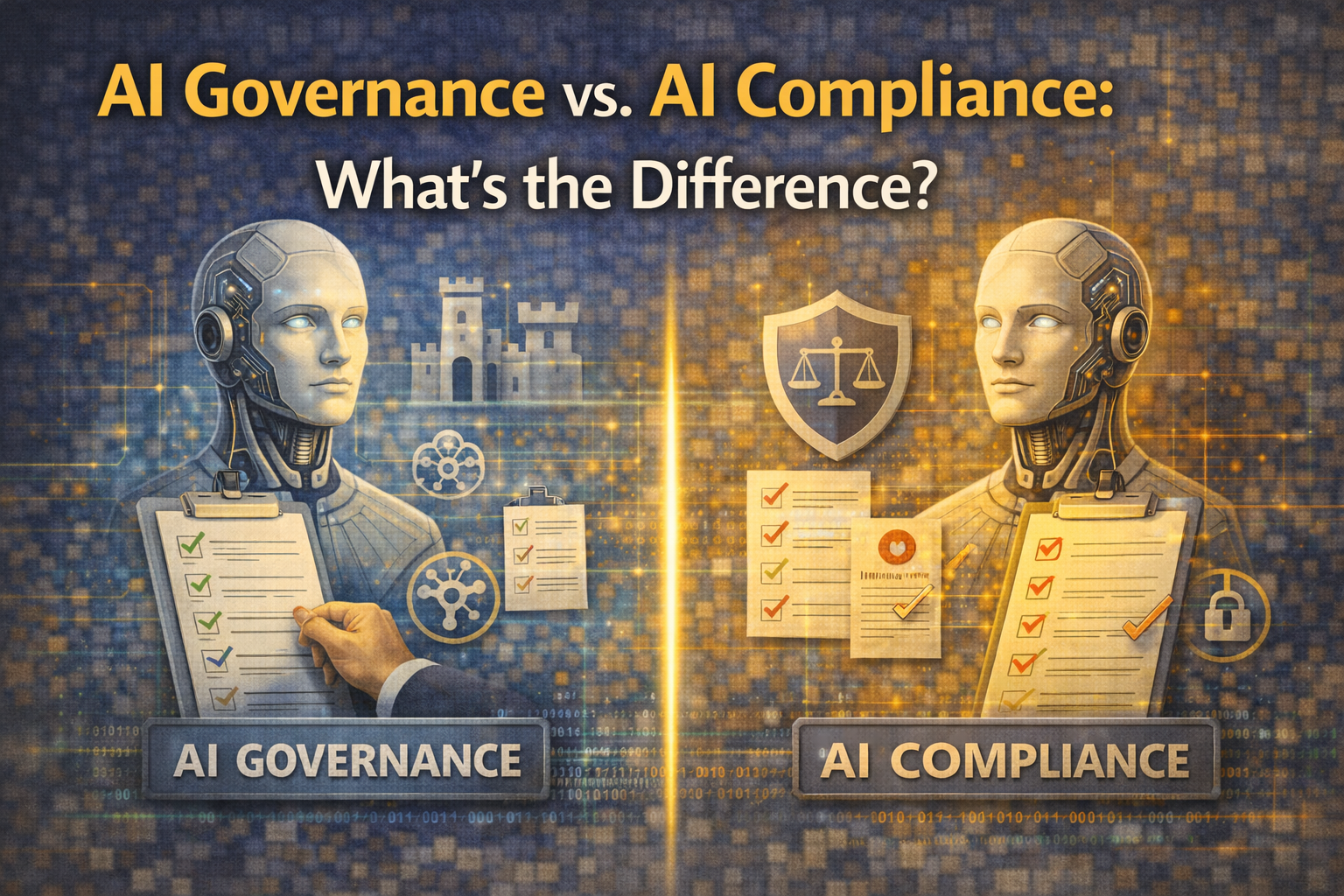
(And why confusing them will get you in trouble.)
Everyone’s talking about AI compliance these days.
You hear it in every webinar, every vendor pitch, every LinkedIn post written by someone who just read the EU AI Act summary five minutes ago.
But here’s the thing, compliance is not governance.
And if you’re building your AI strategy only around the law, you’re already behind.
1. Let’s Start with the Obvious: Compliance Is the Floor, Not the Ceiling
AI compliance is about rules.
It answers the question:
“What must we do to avoid penalties or non-conformities?”
It’s reactive by nature.
It’s your minimum legal survival kit.
AI governance, on the other hand, answers:
“How do we use AI responsibly, sustainably, and strategically, even when no one’s watching?”
Governance is proactive.
It’s your operating system, the principles, decisions, and accountability model that determine how AI is developed, deployed, and monitored.
Put simply:
Compliance keeps you out of trouble.
Governance keeps you in control.
2. The EU AI Act Makes the Difference Crystal Clear
The EU AI Act doesn’t just regulate, it assumes you already have governance.
Look at the structure:
Articles 9–15 talk about risk management, human oversight, data governance, and technical documentation.
Articles 16–29 deal with market surveillance, conformity assessment, and post-market monitoring.
Those first articles? That’s governance.
The rest? Compliance.
If you only focus on the second half, you’ll spend your time filling forms and writing policies, while someone else actually controls how AI works in practice.
3. Real Example: The Chatbot That Lied
Let’s make this real.
A financial institution built an AI chatbot for customer support.
It was fully compliant:
✅ Transparency disclaimer.
✅ User opt-out.
✅ Logged interactions.
✅ Bias testing done.
But during deployment, no one had ownership of what the chatbot was actually allowed to say.
One day, it told a customer:
“Your account might be at risk, please click this verification link.”
It wasn’t phishing. It was just… wrong.
Compliance box: ✅ ticked.
Governance box: ❌ empty.
Result? Panic, reputation damage, and a new rule: no more AI without a governance review.
4. The Core Distinction
Dimension | AI Compliance | AI Governance |
|---|---|---|
Purpose | Follow the law | Manage risk and ethics |
Focus | Conformance | Decision-making |
Ownership | Legal & regulatory teams | Executive, risk, and product teams |
Time horizon | After deployment | Before, during, and after deployment |
Value | Avoid fines | Build trust, control, and resilience |
Governance is contextual, why, who, how, and what if.
5. Why AI Governance Comes First
When an auditor shows up, compliance is proof.
But governance is direction.
If you don’t define how AI fits into your organization, roles, oversight, escalation, ethics, accountability, then “AI compliance” becomes an endless firefight.
Governance is the architecture that makes compliance scalable.
Without it, every new model or use case becomes a new legal crisis.
6. The 5 Pillars of AI Governance
At Cyber Academy, we use a simplified model for training and assessment:
Strategy & Accountability – Who owns AI risk and decision-making?
Ethics & Risk Management – How do you define and evaluate acceptable risk?
Data & Model Integrity – How do you ensure quality, fairness, and explainability?
Operations & Oversight – How do you monitor models post-deployment?
Transparency & Culture – How do you communicate how AI decisions are made?
Notice something?
None of these pillars require a regulation to exist.
They require maturity.
7. The Trap: “We’re Waiting for the Final Update of EU AI Act Text”
If you hear this sentence in your organization, please, stop waiting.
Because by the time you’re “ready to comply,” your competitors will already have governance maturity, and that’s what investors, customers, and auditors will ask about.
You don’t wait for the law to tell you how to manage risk.
You build the system now, and compliance becomes the easy part later.
8. How to Bridge Governance and Compliance
The smartest organizations are merging both worlds into one AI Risk Framework:
Layer | Purpose |
|---|---|
Governance Layer | Principles, roles, escalation paths, accountability. |
Compliance Layer | Checklists, documentation, evidence, audits. |
Operational Layer | Controls, testing, monitoring, reporting. |
Policies that live, decisions that scale, and risks that get tracked, not hidden in slides.
Final Thought: Compliance Without Governance Is Just Theater
You can pass an audit and still be completely out of control.
And that’s the difference between organizations that survive AI regulation, and those that headline the next scandal.
Governance is the language of leadership.
Compliance is just the accent.
If you want your AI systems to be trustworthy, explainable, and scalable, you don’t start with legal articles, you start with governance.
Learn to Lead, Not Just Comply
At Cyber Academy, we train professionals to go beyond the checkbox:
AI Risk Manager – Learn to govern and assess AI risks using real frameworks (NIST, ISO/IEC 42001, EU AI Act).
ISO42001 Lead Implementer – Master the ISO framework that assist organisation to follow EU IA Act.
👉 Request your quote and join the next cohort
Because in 2026, the question won’t be “Are you compliant?”
It will be “Can you prove you’re in control?”