

(Because red/yellow/green slides died in 2015.)
Let’s be honest.
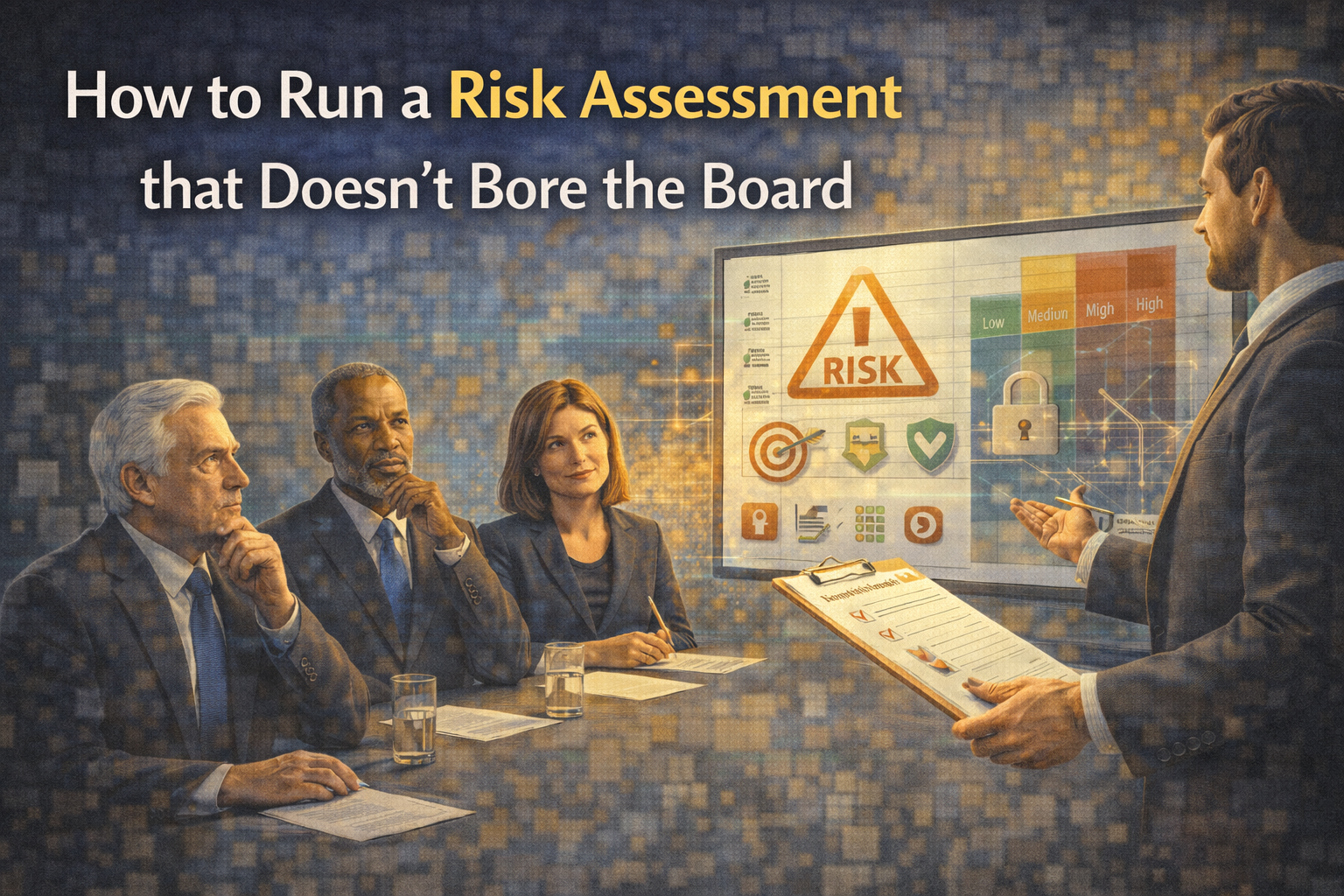
Most board-level risk reviews sound like this:
“Here’s our risk matrix. Top right: cyber, supply chain, and third parties. Bottom left: everything else.”
Cue the polite nods. The CFO checks emails. The CEO says, “Looks fine.”
Meeting over. Nothing changes.
That’s not risk management. That’s risk theatre.
If you want your board to actually care, not just endure your slides, you need to turn risk assessment from a reporting ritual into a decision conversation.
Here’s how.
1. Start with What the Board Actually Cares About
Executives don’t care about risk methodology.
They care about business exposure, money, and momentum.
So stop opening with probability/impact scales.
Start with one slide that says:
“Here are the top 5 things that could stop us from meeting this year’s objectives.”
That’s it.
No jargon, no color palette. Just context and consequence.
If you don’t link your assessment to strategic goals, you’re just making pretty diagrams.
2. Kill the Heatmap, Tell the Story
You know that matrix with 20 colorful dots?
Yeah, the board hates it. They don’t know what each dot means, and they won’t ask.
Instead, tell stories.
“Last quarter, we came within two days of missing a customer SLA because a single vendor failed.”
“That’s why supplier resilience is now risk #2, and here’s what we’re doing about it.”
Stories make risk tangible.
Heatmaps make it abstract.
Use risk scenarios, not tables, to make your point.
The human brain understands narrative, not axes.
3. Quantify, Even Roughly
The moment you add a number, attention spikes.
“If this risk materializes, we lose ~€1.2M and 10 days of production.”
Now you’re speaking the board’s language.
You don’t need Monte Carlo simulations, just plausible ranges based on impact, cost, or time.
Boards can’t prioritize red vs. orange,
but they can prioritize “€1.2M loss vs. €200K delay.”
Translate risk into money, minutes, or media headlines.
4. Turn “Assessment” into “Options”
Boards don’t want a list of problems, they want decisions.
For each top risk, present:
What it is.
Why it matters.
Three treatment options, with tradeoffs.
Example:
“To reduce supplier dependency risk, we can:
Diversify vendors (cost: €300K/year)
Negotiate stronger SLAs (cost: €0, slower delivery)
Accept the risk (exposure: €1.2M).”
Now you’re not just reporting risk, you’re enabling governance.
That’s what the board is paid to do.
5. Show Movement, Not Perfection
Boards don’t care about how detailed your register is.
They care about progress.
If every quarter your risk ranking looks identical, you’ve lost credibility.
Show trendlines:
“3 risks closed this quarter.”
“2 new ones emerged.”
“Residual exposure down 15%.”
Momentum beats perfection.
Even incremental progress tells a story of control.
6. Use Visuals with Purpose
No more traffic lights.
Instead:
One slide per top risk.
Title: the scenario in plain English (“Major outage from single cloud provider”).
Subtitle: quantified exposure.
One graph: trend over time.
One box: decisions made or pending.
If your risk deck reads like a 90s PowerPoint, you’ve lost before you began.
Make it look like a business dashboard, not a compliance report.
7. Include a Win
Never walk into a board session with only bad news.
Highlight one success story, a mitigated risk, a faster control response, a test that worked.
Boards are human too, they remember wins better than warnings.
Show that risk management delivers value, not just paperwork.
8. Keep the Methodology, Lose the Lecture
Nobody on the board wants a 10-minute explanation of ISO 31000 or FAIR.
Have it in your backup slides, sure, but don’t lead with it.
Start with impact, end with decisions.
Keep the frameworks invisible, like plumbing.
They should support the story, not steal the stage.
9. Fix the Follow-Up
Here’s where 90% of risk sessions fail: no one tracks what the board decided.
Three months later, you’re back with the same slide.
Fix it:
Record each decision (accept / mitigate / transfer).
Assign an owner.
Track progress in your next report.
Boards don’t need more meetings, they need closure.
The Point
A risk assessment that bores the board is a wasted opportunity.
You’ve got their attention for 20 minutes, make it count.
Your job isn’t to show a matrix.
Your job is to make the organization see itself clearly, and act accordingly.
When you stop presenting risk as paperwork and start presenting it as strategy, people stop tolerating your session and start depending on it.
Turn Risk into a Strategic Language
That’s what we teach in the ISO 31000 Lead Risk Manager trainings:
how to make risk visible, measurable, and meaningful at the leadership level.
👉 Request your quote & join the next cohort
Because risk isn’t boring, unless you make it that way.