


NIS2 – Training Courses(And why “we have a policy for that” won’t be enough this time.)
NIS2 is not another cybersecurity checkbox.
It’s a shift in accountability, from IT to governance.
For the first time, directors can be held personally liable for failures in cyber resilience.
So when the first wave of NIS2 audits starts to roll in, expect auditors to go beyond the usual “do you have a policy?” routine.
They’ll be looking for proof of execution, traceability, and management involvement.
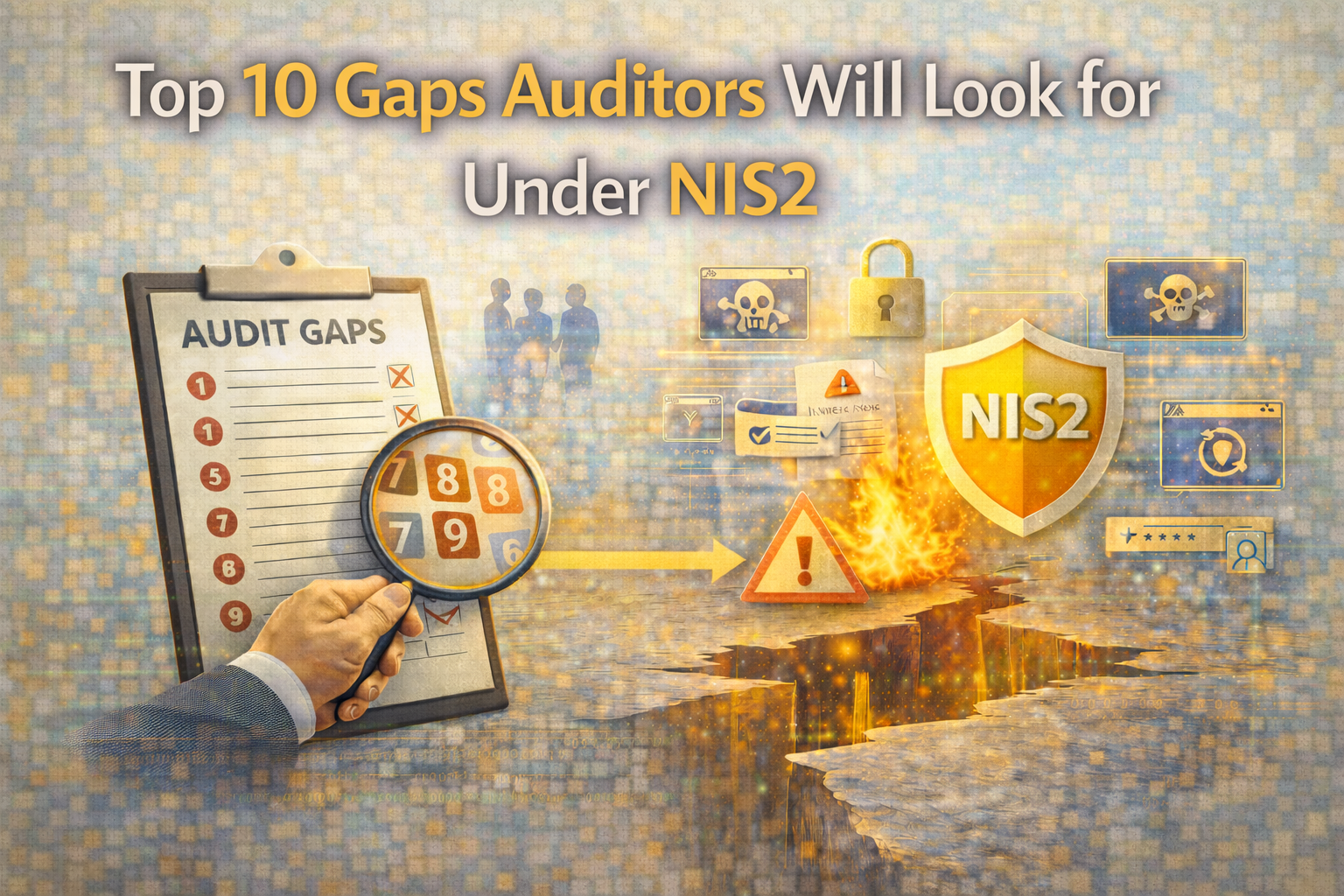
Here are the ten real-world gaps that will make or break your NIS2 audit.
Not theory, the stuff we already see when assessing organizations across Europe.
1. Missing Governance Evidence at the Top
NIS2 moves cybersecurity into the boardroom.
If your directors can’t demonstrate oversight, you’ve failed the first test.
What auditors will check:
Is cybersecurity a recurring board agenda item?
Are roles and responsibilities formally assigned at the management level?
Is there documented accountability for risk acceptance?
Fix it:
Keep minutes, sign-offs, and presentations.
Evidence is king, “the board was informed” means nothing if it’s not written down.
2. The “Policy ≠ Practice” Syndrome
Most organizations have policies that look perfect, on paper.
Auditors will go straight past them to see if controls are actually in use.
What they’ll ask:
“Show me how this policy is implemented.”
“Who reviewed it last?”
“When was it communicated to staff?”
Fix it:
Version control, distribution logs, and training records.
If nobody knows the policy exists, you might as well delete it.
3. No End-to-End Risk Management
Under NIS2, risk management isn’t a side dish, it’s the main course.
You can’t just say, “We’ve done a risk assessment.”
Auditors will look for:
A formal methodology (preferably aligned with ISO 31000 / 27005).
Documented risk owners.
Treatment plans with follow-up evidence.
Fix it:
Run risk reviews quarterly or even monthly, not annually.
Update when context changes, not just before the audit.
4. Weak Incident Response Integration
NIS2’s 24-hour notification requirement changes everything.
Auditors will test whether your incident process can actually deliver that speed.
What they’ll check:
Clear escalation paths and named roles.
Playbooks tested in simulations.
Incident logs aligned with reporting obligations.
Fix it:
Don’t just have a plan, run drills.
Auditors can tell in two minutes whether you’ve ever tested it.
5. Supplier & Third-Party Blind Spots
Under NIS2, your suppliers are your problem.
Auditors know this is where most organizations fail.
What they’ll check:
Is there a vendor risk management process?
Do contracts include cybersecurity clauses and SLAs?
Is supplier performance monitored regularly?
Fix it:
Build a lightweight third-party risk register.
Start with critical vendors, even a simple scoring model beats ignorance.
6. No Real-Time Awareness of Compliance
Many companies still treat compliance as “annual reporting.”
Under NIS2, auditors will expect continuous awareness of compliance posture.
What they’ll look for:
KPIs or dashboards showing control performance.
Recent internal audits or self-assessments.
A process for capturing lessons learned.
Fix it:
Implement a simple compliance dashboard, monthly updates, red/amber/green.
It’s not about perfection; it’s about visibility.
7. Incomplete Business Continuity Integration
Cyber resilience under NIS2 isn’t just IT recovery, it’s business continuity.
If your business impact analysis (BIA) lives in another department, that’s a red flag.
Auditors will ask:
“When was your last continuity test?”
“Which critical services does your BCP cover?”
“Who validated recovery times?”
Fix it:
Link your cyber incident playbooks to your BCP scenarios.
Auditors will expect to see that alignment, not two separate universes.
8. Training That Exists Only on PowerPoint
NIS2 explicitly requires awareness and training.
Auditors will test depth, not existence.
They’ll ask:
“How do you tailor training by role?”
“What’s your completion rate?”
“When was your last phishing simulation or table-top exercise?”
Fix it:
Measure impact, not attendance.
Show behavioral improvement, not just slides and sign-ins.
9. Documentation Chaos
Auditors don’t just look for policies, they look for coherence.
They’ll expect a structured documentation system: policies, procedures, guidelines, records, each with clear ownership and traceability.
Fix it:
Implement a simple documentation framework:
Policy (what & why)
Procedure (how)
Record (evidence)
If it takes more than two clicks to find a document, you’re not ready.
10. Controls Without Metrics
Having controls isn’t the same as knowing if they work.
Depending on the maturity level expected, auditors under NIS2 will want to see effectiveness evidence, not just existence.
They’ll ask:
“How do you measure the performance of your security controls?”
“When was this control last tested?”
Fix it:
Link controls to KPIs or KRIs.
Example: “Patching within 14 days, 96% compliance.”
Numbers talk. Narratives don’t.
Bonus: “Copy-Paste Compliance”
Auditors can smell it instantly.
If your documentation looks like it was generated by ChatGPT or a generic ISO template, they’ll start digging, hard.
Fix it:
Make your framework yours.
Tailor roles, risk appetite, and metrics to your actual operations.
Compliance is easy to fake until someone starts asking why you did things a certain way.
Final Thought
NIS2 doesn’t demand perfection, it demands proof.
If you can’t show that your cybersecurity governance is real, repeatable, and traceable, you’re not compliant, no matter how pretty your policies look.
By the time the auditor arrives, it’s too late to start aligning.
The smartest organizations are doing it now, turning NIS2 into a driver for structured, board-level resilience.
How to Get Ready
That’s exactly what we cover in the NIS2 Lead Implementer program at Cyber Academy:
Governance structure design.
Risk & incident frameworks aligned with NIS2 Articles 21–23.
Audit-proof documentation models.
👉 Request your quote. Join the next cohort.
Because NIS2 isn’t about passing an audit.
It’s about proving your organization actually runs the way you say it does.