


(Because shouting “It’s a compliance risk!” has never won a budget.)
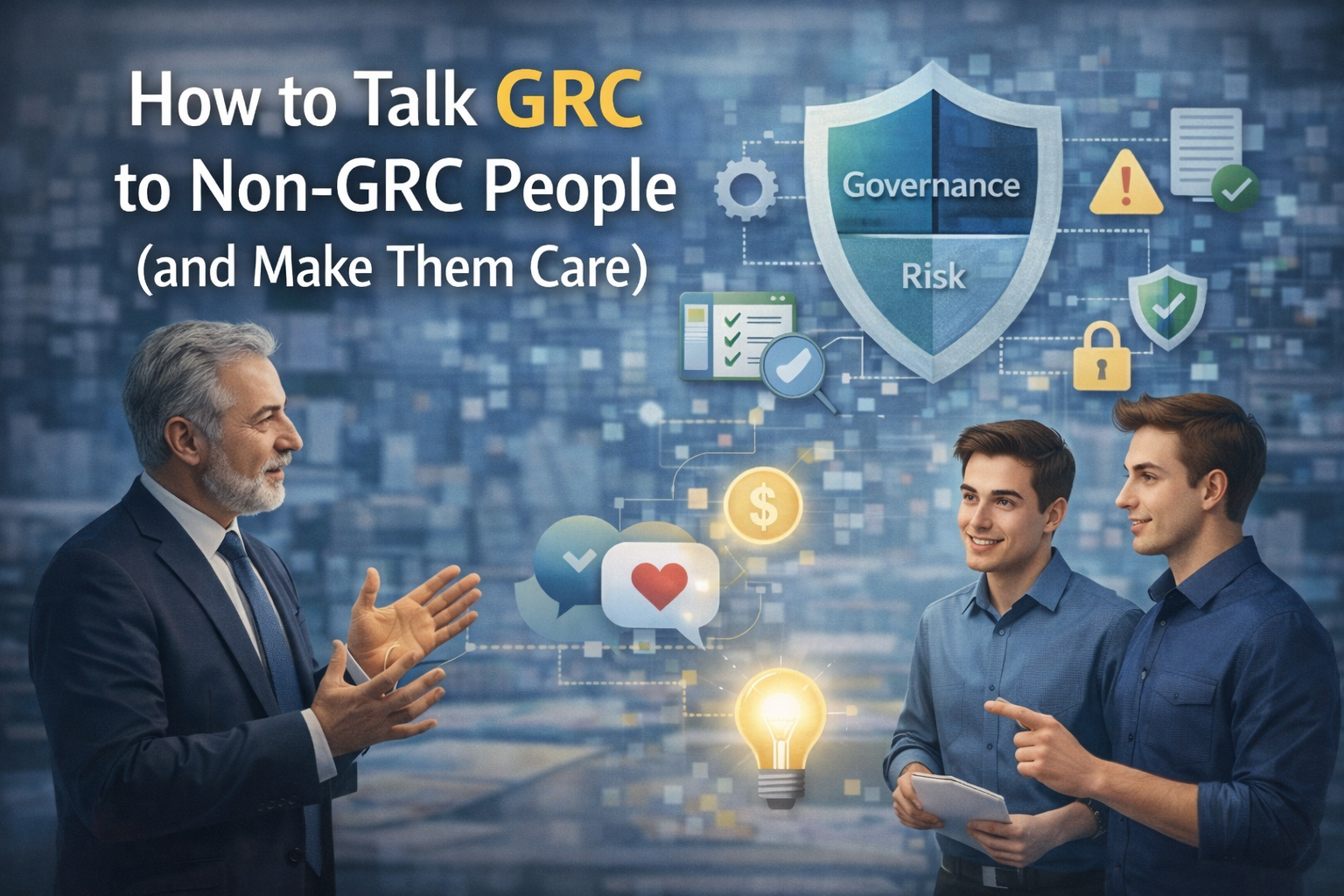
Let’s be real: nobody outside your team dreams about governance, risk, or compliance.
The CFO cares about cost, the CMO cares about reputation, the CTO cares about uptime.
You? You care about frameworks, control maturity, audit readiness, and residual risk.
And that’s the problem.
You’re right, but you’re speaking the wrong language.
Here’s how to make people actually listen when you talk GRC.
1. Stop Leading with the Framework
“We’re implementing ISO 27005 to align with the risk management principles of 31000.”
That’s how you lose a room in ten seconds.
Nobody outside GRC cares which standard you use.
They care about outcomes, “Will this prevent a fine?”, “Will this make my life easier?”, “Will this keep us out of the news?”
So reframe:
-
Don’t say “We need a business continuity plan.”
Say “If our main system dies, how fast can we be back online?” -
Don’t say “We’re updating our ISMS.”
Say “We’re tightening how we handle client data, because we’d rather not explain a breach to the regulator.”
Speak in impact, not acronyms.
2. Translate Risk Into Business Metrics
If your heatmap looks great but no one cares, it’s not because the company is immature, it’s because you never connected risk to their scoreboard.
Every function already measures something:
-
Sales tracks revenue.
-
Ops tracks uptime.
-
HR tracks retention.
-
Finance tracks cost.
Your job is to map GRC outcomes to those numbers.
Example:
“Implementing supplier risk scoring reduces downtime risk by 30%.”
“This control saves us ~€200K/year in potential fines and incident handling.”
Once GRC speaks in euros or uptime, it becomes strategy, not paperwork.
3. Use Stories, Not Spreadsheets
Humans don’t remember risk matrices, they remember pain.
When you say “third-party dependency risk,” they nod and forget.
When you say, “Remember when our SaaS vendor went down for 36 hours and the CEO called you at 2 a.m.?”, they feel it.
Use stories:
-
“Here’s what happened to a peer company.”
-
“Here’s how a similar incident cost €2M in downtime.”
-
“Here’s the audit finding that killed a contract renewal.”
Turn abstract risk into something they can visualize.
That’s when they start caring.
4. Don’t Scare, Inspire
Fear works once.
But if every GRC conversation sounds like “If you don’t do this, we’ll get fined,” you’re training people to tune you out.
Good GRC leaders talk about trust, resilience, and credibility, not fear.
Try this shift:
-
From “We’ll fail the audit.” → “This will make our next audit a non-event.”
-
From “We might get fined.” → “This keeps us in the regulator’s good books.”
-
From “You must do this.” → “Here’s how this helps you sleep better.”
You’re not the “Department of No.” You’re the Department of How.
5. Learn to Time Your Message
You can have the best message in the world, if you deliver it when everyone’s firefighting, it’ll land like a GDPR cookie banner.
Timing is strategy.
-
Talk risk right after a near miss.
-
Talk governance before a new project starts.
-
Talk compliance when leadership’s focused on reputation or funding.
Ride the wave. Don’t fight it.
6. Visuals Beat Documents
Nobody reads your 15-page risk report. Not even your manager.
Use visuals:
-
One-slide dashboards for execs.
-
RAG (red–amber–green) instead of 0–5 scales.
-
Trend arrows, not static numbers.
The point isn’t precision, it’s decision-making.
If they can’t act on it in 30 seconds, you’ve lost the room.
7. Show That GRC = Enabler
The most advanced companies already know: GRC isn’t a blocker, it’s a competitive advantage.
When you talk to non-GRC people, show them the upside:
-
Risk management = faster approvals, fewer surprises.
-
Compliance = easier client onboarding.
-
Governance = cleaner decisions, fewer fire drills.
You’re not the brakes. You’re the traction control.
8. Speak With Empathy, Not Superiority
You know frameworks. They know business. You need each other.
Don’t be the “I told you so” guy when things go wrong.
Be the one who says, “Let’s make sure this doesn’t happen again, together.”
GRC isn’t about rules, it’s about relationships.
You can automate controls, but you can’t automate trust.
9. The Quick Reframe Guide
|
❌ Don’t say |
✅ Say instead |
|---|---|
|
“We need to comply with ISO 27001.” |
“We need to prove we protect customer data, that’s what ISO helps us show.” |
|
“This is a non-conformity.” |
“We found a weak spot, and fixing it improves our resilience.” |
|
“We must follow this policy.” |
“This policy saves us from making the same mistake twice.” |
|
“The risk score is high.” |
“If this happens, we lose a week of operations.” |
Final Thoughts
GRC is a translation job.
You translate frameworks into language that people understand and act on.
The more you speak business, the less you need to shout “compliance.”
The goal isn’t to make them fear you, it’s to make them trust you.
When you stop talking GRC at people and start talking with them, everything changes:
budgets, support, adoption, culture.
Want to Get Better at This?
That’s exactly the kind of soft skill we sharpen in our advanced leadership tracks:
-
ISO 31000 Lead Risk Manager – for communicating risk with impact.
-
NIS2 Lead Implementer – for turning regulation into strategy.
-
Cyber Academy Coaching Sessions – because frameworks don’t teach persuasion.
👉 Join the next cohort or request private coaching
Because sometimes, the real control you need isn’t in Annex A, it’s in how you talk.