


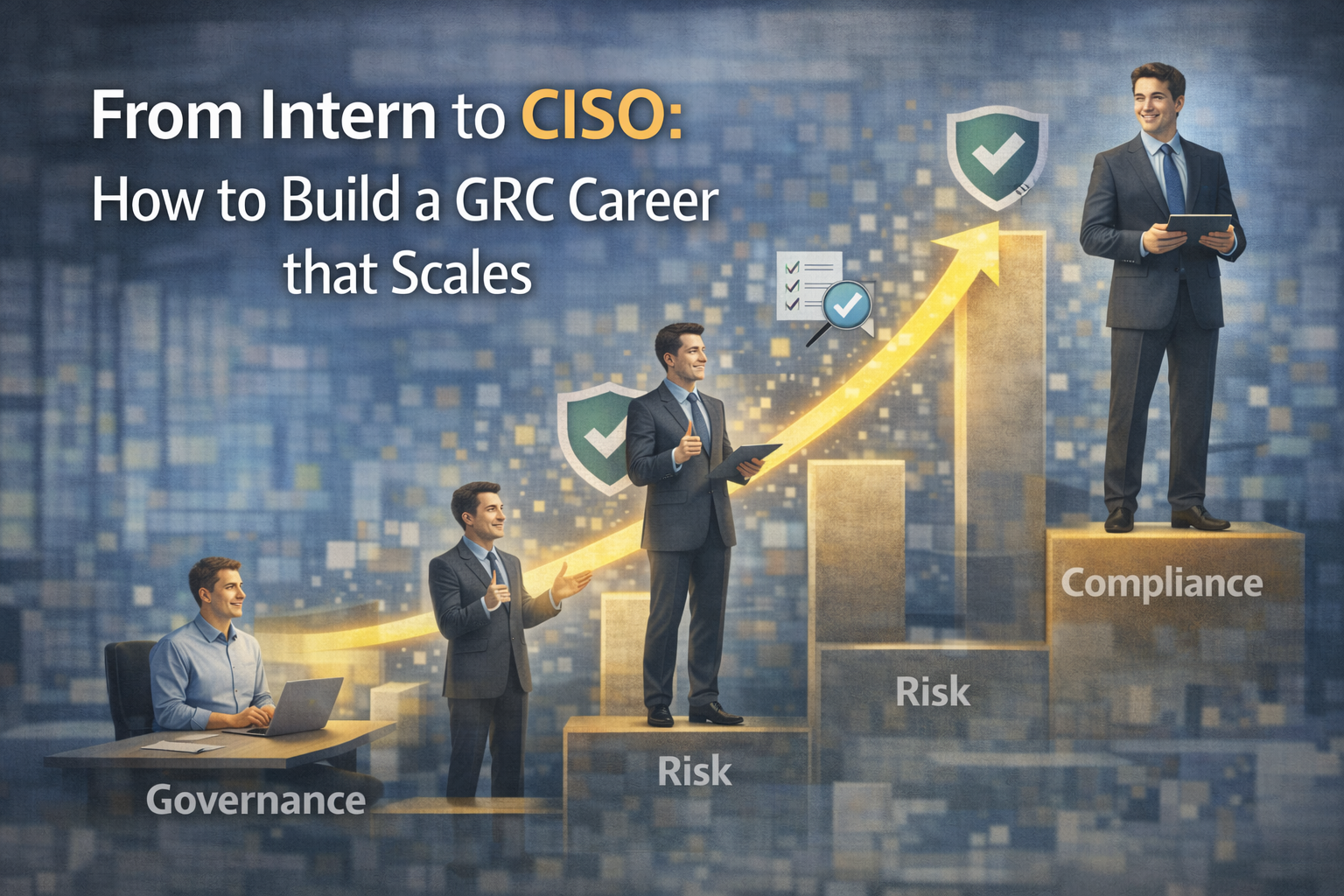
Nobody starts a GRC career thinking, “One day I’ll be a CISO.”
Yet the people who reach that level rarely follow a linear path ; they follow a scalable one.
If you want to go from intern to CISO, you don’t need luck. You need clarity, momentum, and the right habits.
Most juniors enter GRC through chaos.
You get thrown into risk registers you didn’t create, evidence folders with cryptic names, half-written policies, audit pressure, and Slack messages like “Can you find the Pentest Report from 2021?”
The jump from “GRC intern” to “trusted advisor” to “CISO” looks impossible.
Here’s the truth:
GRC is the most scalable career in cybersecurity ; if you know how to grow intentionally.
Not by memorising frameworks.
Not by collecting certificates.
But by developing the skills that turn analysts into leaders.
This is the roadmap.
1. Master the Basics Before You Chase Titles
At the beginning, your job is not to be brilliant.
Your job is to become reliable, structured, and accurate.
What this looks like in practice:
learn how evidence works
understand how audits actually happen
get comfortable with Excel and dashboards
read ISO 27001 like a novel ; not like a law text
help others shine by being organised
document everything clearly
Anecdote:
The best junior analyst I ever worked with didn’t know 27001 clause numbers.
But he could find any document in 30 seconds and explain it in plain language.
His speed made him indispensable.
Lesson:
If you master the fundamentals, senior people will trust you with real work fast.
2. Build Your GRC “Operating System” Early
Great GRC pros don’t rely on memory ; they rely on systems.
Create your own:
checklist for evidence collection
template for control reviews
tracker for audit readiness
structure for risk updates
dashboard for weekly progress
When you work with a system, two things happen:
You look senior far earlier than your title suggests.
You avoid the burnout that destroys many early careers.
3. Learn to Translate, Not Just Execute
The biggest jump in your career happens when you stop doing tasks and start making meaning.
GRC analysts who grow fast are the ones who can explain:
what a risk means
why a control matters
how an incident impacts the business
what the auditor is really asking
what decision the executive needs to make
This shift makes you a partner, not an assistant. People rise in GRC when they learn to translate complexity into clarity.
4. Become the Bridge Between IT, Security, and the Business
GRC is the only domain that touches everyone: HR, Legal, IT, Engineering, Product, Operations, Finance, Leadership.
If you want to climb fast:
learn how IT works
learn how engineering ships code
learn how finance thinks (cost, ROI, exposure)
learn how operations worry about downtime
learn how legal handles liability
A story from the field:
One analyst spent 3 months sitting with engineers during stand-ups.
He became the only GRC person who could speak their language.
He was promoted twice in a year ; not because of frameworks, but because of empathy.
Lesson:
GRC careers scale when you become the human glue of the organisation.
5. Own Something (Even Small) and Deliver It Perfectly
The fastest careers in GRC come from ownership, not tasks.
Examples of things a junior can fully own:
access review workflow
vendor risk assessments
incident reporting flow
monthly risk update summary
quarterly compliance dashboard
Why this matters:
Owning a process shows maturity, foresight, and leadership.
It also signals to your CISO: “I can handle more.”
Showing you can own one thing is the first proof you can own bigger things.
6. Learn to Present Clearly, It’s Your Superpower
You can’t become a CISO if you can’t explain risk to non-technical people.
Start early:
summarise instead of over-explaining
use one slide, not twelve
replace jargon with consequences
talk impact, not clauses
lead with “here’s what we need from you”
Your communication skills will take you further than any certification.
7. Develop Judgment, the Skill That Makes or Breaks CISOs
GRC is not about following rules.
It’s about making decisions under uncertainty.
Judgment is built by asking questions like:
What matters most right now?
What’s the simplest solution that reduces the most risk?
Is this a real risk or a documentation problem?
What decision is the executive really trying to make?
Where should we invest our limited time?
Judgment is what turns GRC analysts into leaders.
8. Become Obsessively Good at Execution
Leadership will trust you when you:
deliver early
deliver clean
deliver without drama
close the loop
create clarity instead of confusion
CISOs don’t rise because they’re the smartest ; they rise because they’re the most reliable.
If you consistently deliver, people will put you in rooms you’re “not supposed” to be in yet.
9. Build a Personal Brand Inside the Organisation
Being known internally accelerates your progression massively.
How to do this authentically:
share insights
help other teams
explain frameworks simply
be the person who solves problems fast
bring positive energy to meetings
Visibility matters. Influence matters. Value creation matters.
10. When You’re Ready: Think Like a CISO Long Before You Become One
CISO is not a technical title ; it’s a leadership one.
To prepare:
think in systems, not tasks
think in outcomes, not controls
think in strategy, not checklists
think in decisions, not documents
think in business impact, not compliance scores
CISOs ask different questions:
“Does this reduce risk?”
“How does this support growth?”
“What is the Board worried about?”
“What’s the simplest way to protect the business?”
If you start thinking like this early, your progression becomes inevitable.
Final Thought
A GRC career doesn’t scale because of certificates, tools, or frameworks.
It scales because you:
become reliable,
become clear,
become useful,
become a translator,
become a leader.
From intern to CISO is not a dream.
It’s a sequence of small, smart steps that compound over time.