
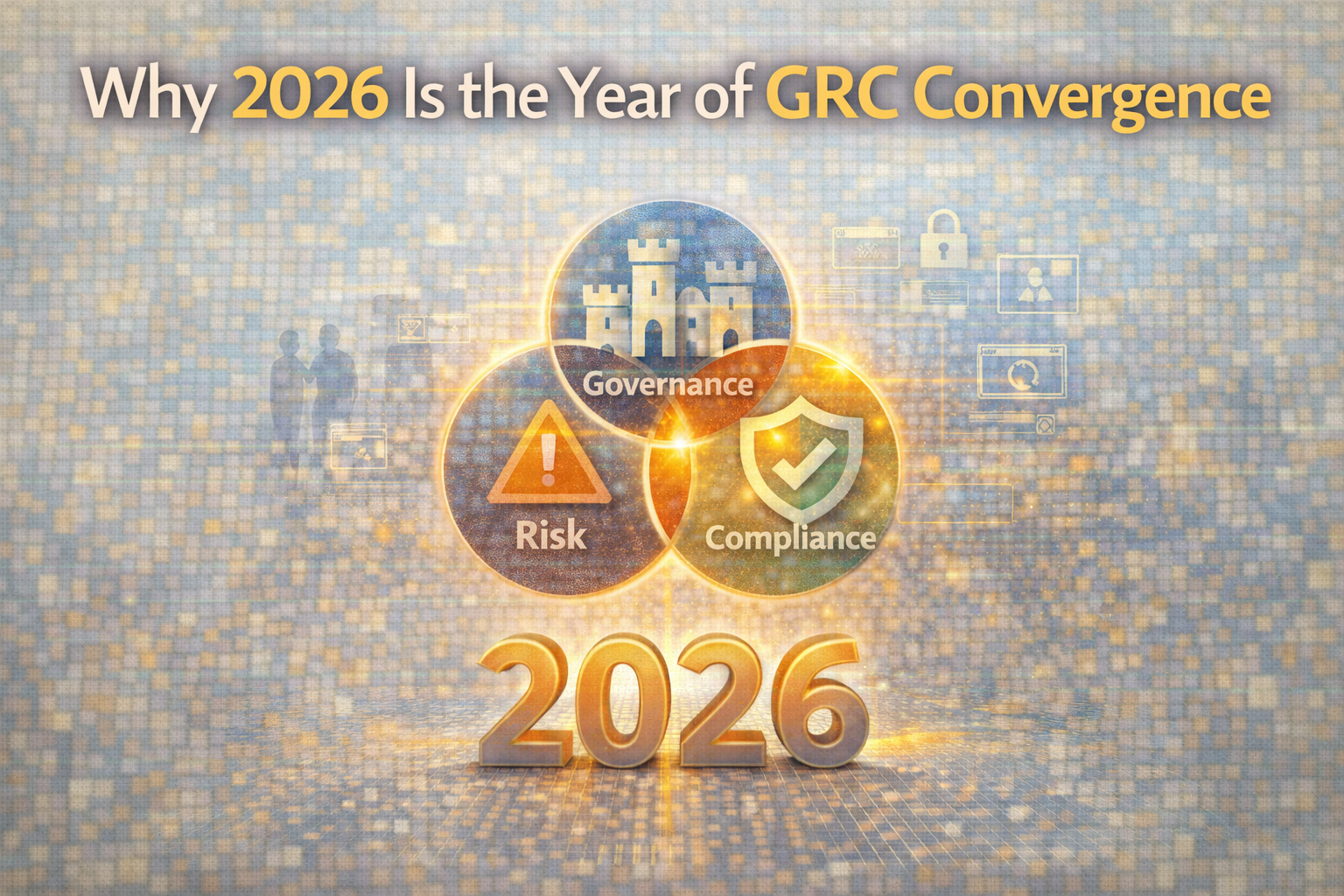
(And why your silos won’t survive it.)
For years, organizations treated governance, risk, and compliance as three separate planets orbiting the same sun.
One team ran ISO.
Another handled audit.
Legal did GDPR.
The board nodded once a year and hoped for the best.
That world is ending.
By 2026, the companies that survive the regulatory storm, NIS2, DORA, the AI Act, The CRA Act, The DATA Act, ESG, privacy, you name it, will be the ones that finally stop managing frameworks in isolation.
We’re entering the era of GRC convergence.
1. The Perfect Storm Has a Name: Europe
Europe didn’t just tighten regulations, it connected them.
NIS2 brought cybersecurity and governance to the boardroom.
DORA forced the financial sector to treat ICT resilience as risk management, not IT hygiene.
The AI Act introduced accountability layers and human oversight requirements that look a lot like ISO 31000.
ESG frameworks started demanding evidence of governance and transparency, just like ISO 27001.
These aren’t “different” frameworks anymore. They’re different expressions of the same principle:
You must prove that your organization is in control, across risks, systems, and decisions.
The silos were convenient. But they’re not defensible anymore.
2. From “Compliance Projects” to Continuous Governance
Remember when compliance used to be a project?
A start date, a few consultants, some policies, and a badge at the end?
That era is dead.
2026 marks the point where compliance becomes continuous.
Auditors, regulators, and clients no longer ask “Do you have a policy?”
They ask “Can you show me proof, right now?”
Convergence is what makes that possible, one shared governance model feeding:
Risk registers,
Audit findings,
Incident reports,
Supplier evaluations,
AI model risk assessments,
ESG indicators.
One ecosystem, many lenses.
That’s what “GRC convergence” really means.
3. The Business Side Finally Woke Up
For the first time, the board actually cares about GRC, not because it’s trendy, but because fines, accountability, and resilience are now strategic issues.
Boards are starting to see what we’ve known for years:
GRC maturity = investor confidence.
Audit readiness = market credibility.
Risk transparency = decision speed.
By 2026, GRC isn’t a checkbox. It’s a competitive advantage.
The companies that show integrated, data-driven governance will win contracts, funding, and public trust faster than those still buried in silos.
4. Technology Finally Caught Up
Let’s be honest, Excel got us far, but it’s time.
Modern GRC platforms now integrate:
Risk management,
Compliance mapping,
Control automation,
Real-time dashboards.
The tools are ready.
The question is whether your organization is.
Because in 2026, GRC will be measured in data, not documents.
If you can’t visualize your control landscape in one dashboard, you’re already behind.
5. AI and Automation Will Force Integration
Ironically, the same AI that’s complicating compliance will also make convergence inevitable.
AI-driven GRC platforms can already:
Tag controls across multiple frameworks automatically.
Flag conflicting requirements.
Predict risk trends using past incidents.
This isn’t the future, it’s starting now.
And to make AI governance effective, you’ll need centralized oversight that connects your cybersecurity, risk, and compliance functions.
GRC convergence isn’t a choice anymore, it’s infrastructure.
6. What Convergence Looks Like in Practice
Here’s what the mature 2026 GRC model looks like:
Old Way | New Way |
|---|---|
Separate ISO, NIS2, DORA projects | Unified GRC roadmap |
Risk, audit, compliance teams disconnected | Shared data model, shared dashboard |
Manual evidence collection | Automated control monitoring |
Framework-driven mindset | Outcome-driven governance |
GRC as cost center | GRC as strategic function |
Efficiency.
Instead of managing ten frameworks separately, you manage one governance system that answers to all of them.
7. The Human Factor, Still the Hardest Part
You can integrate your tools and frameworks, but if your people still say
“That’s not my responsibility,”
you haven’t converged anything.
True convergence means your organization speaks one governance language.
IT risk, compliance, and business continuity aren’t separate dialects anymore, they’re accents of the same culture.
That’s the leadership challenge of 2026:
Not just systems integration. Cultural integration.
8. How to Prepare Now
If you want to be ready for the 2026 wave:
Map your frameworks. Find overlaps, you’ll be shocked how much redundancy exists.
Centralize ownership. Create one GRC steering committee.
Unify data. Risk, incidents, audit findings, one source of truth.
Upgrade your tooling. Choose platforms that integrate, not isolate.
Train leaders across silos. Your CISO and Compliance Officer should attend the same briefings.
This isn’t “extra work.” It’s consolidation.
And it’s what will separate compliant companies from trusted ones.
Convergence Is Coming, Whether You’re Ready or Not
2026 isn’t the year of a new regulation.
It’s the year when all regulations finally align.
GRC convergence isn’t theory, it’s the new baseline.
You can keep defending your silos and spreadsheets,
or you can build an integrated governance model that finally makes sense of it all.
Because resilience isn’t built on frameworks.
It’s built on alignment.
Ready to Lead the Convergence?
That’s what our DORA Lead Manager, NIS2 Lead Implementer, and ISO 31000 Lead Risk Manager courses are designed for.
Each teaches you how to move beyond compliance, and into real governance.