ISO 9001 - Quality
In our current globalized economy and complex supply chains, John Ruskin’s adage, “Quality is never an accident. It is always the result of intelligent effort” is even more relevant today than it was on the day he said it. Organizations cannot rely on chance and hope to deliver quality products and services; instead, they must establish a consistent and planned approach for managing quality. With over one million certified organizations worldwide, ISO 9001 remains the world’s most well-known standard, which provides organizations with a structured approach for quality management and helps them consistently provide products and services that meet and, where possible, exceed customer requirements.
What is ISO 9001
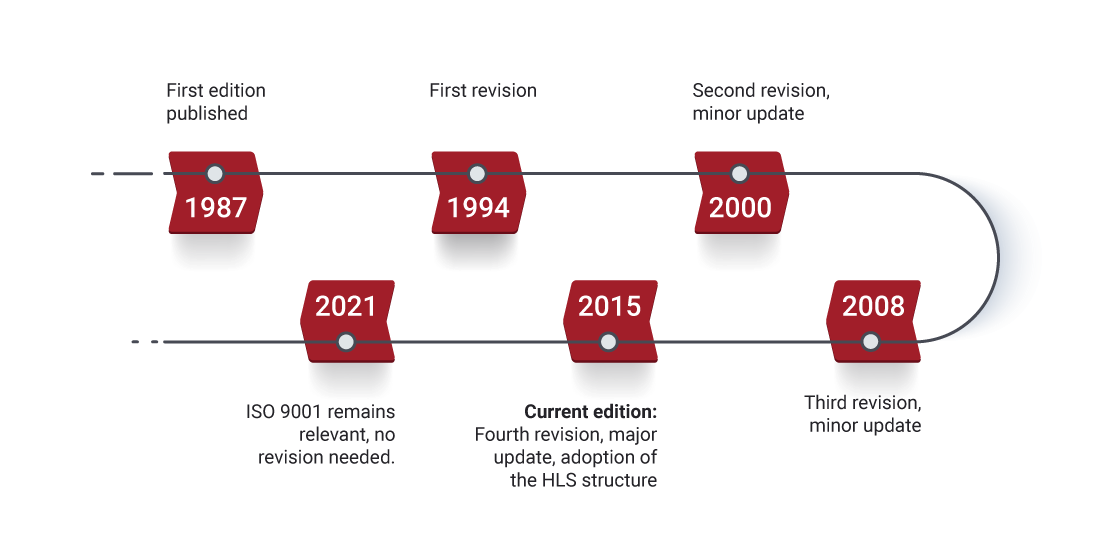
Published initially in 1987, ISO 9001 is the first international management system standard (MSS) that specifies the requirements for the establishment, implementation, operation, maintenance, and continual improvement of a quality management system (QMS) in an organization.
ISO 9001 is based on seven quality management principles and it aims to help organizations be more efficient and improve customer satisfaction. A common misconception is that ISO 9001 is intended for larger companies and manufacturers. However, the requirements of ISO 9001 are generic and applicable to any organization, regardless of its type, size, or the products or services it provides.
Although ISO 9001 was initially published in 1987, it has undergone several revisions in order to keep up with good practices and trends in the business world and ensure continuous suitability. The latest (5th) edition of the standard is titled ISO 9001:2015 Quality Management Systems – Requirements. After running a survey with over 8,000 respondents, in May 2021, the ISO subcommittee for quality systems (ISO/TC 176/SC 2) confirmed that ISO 9001:2015 is still relevant and recommended that it remains unchanged.
Why is ISO 9001 important ?
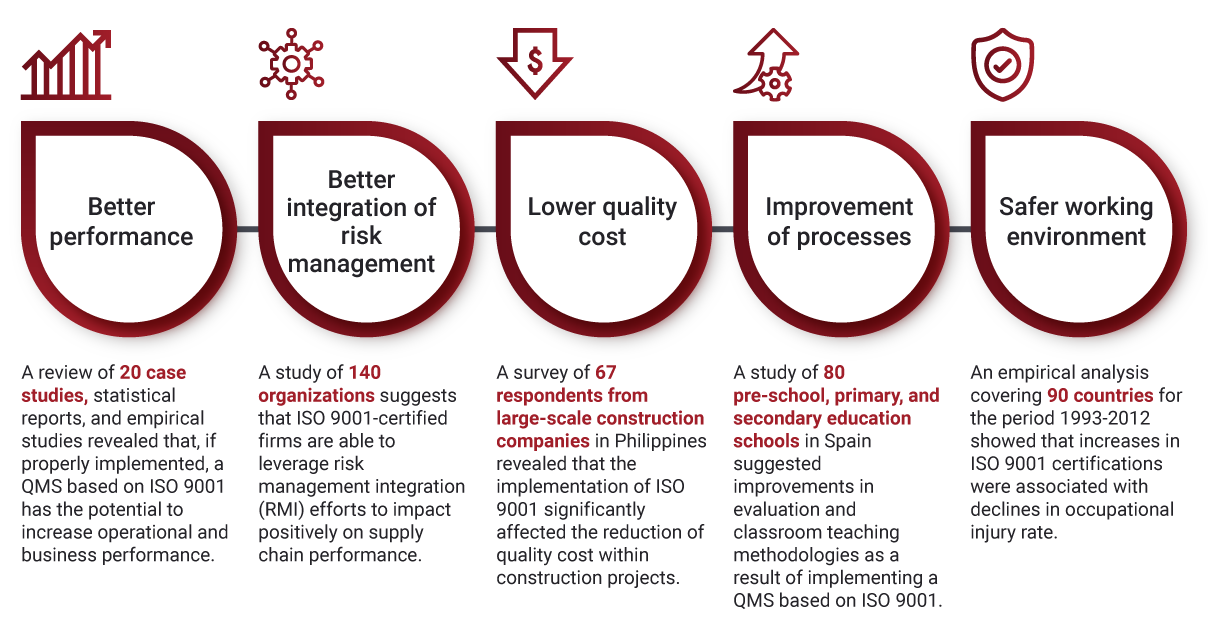
Ever since its initial publication, ISO 9001 has been the most recognized and widely used management system standard. A QMS based on ISO 9001 enables organizations to ensure success in the long term. In addition, a certified QMS provides additional assurance to customers and business associates, which further improves the business of an organization.
A distinct feature of a QMS based on ISO 9001 is that it puts customers first. “Meeting customers’ needs and exceeding their expectations” is engraved in the quality management principles, and is implied continuously on the requirements stated in clauses 4 to 10 of the standard. As such, organizations that implement and establish a QMS based on ISO 9001 will maintain the focus on their customers by continuously identifying their needs and requirements, obtaining feedback from them, and continually improving their products and services to fulfill their needs. This focus on customer satisfaction is one of the key factors that have allowed the ISO 9001 to achieve the landmark status.
Like most of the management system standards, ISO 9001 is structured according to the High-Level Structure (HLS) and shares the common terms and core definitions. This alignment enables an easier integration with other management systems based on standards such as ISO 14001, ISO/IEC 20000-1, ISO/IEC 27001, ISO 22301, etc. Apart from ensuring consistency and reducing costs, integrating several management systems can improve the organization’s ability to successfully address other organizational commitments.
ISO 9001 Foundation
ISO 9001 Lead Implementer
ISO 9001 Lead Auditor
Certification is the easy part. Execution is the job.
Ready to Get Certified and Actually Know What You’re Doing?
Whether you’re targeting ISO 27001, dealing with DORA/NIS2 pressure, or strengthening operational resilience, we train you for the real world: audits, evidence, board questions, and messy constraints.
Official frameworks. Practical execution. Trainers who’ve been in the seat.
Simple. Practical. Certifying.
Let’s turn compliance into a competitive edge — together.
Quick answers before you reach out — and if you’re unsure, we’re one message away.
Questions? We’ve Got You.
1. Are all formats certifying?
Absolutely. Whether you choose classroom, virtual, or self-paced, you’ll follow the official program and be eligible for certification.
2. As there a minimum number of participants for on-site training?
Yes — typically a minimum of 4 participants. For tailored in-company sessions, visit our dedicated page.
3. Will I get access to materials no matter the format?
Yes. All formats include official course materials, whether in print, digital, or platform-based access.
4. How do I choose the best format for my needs?
It depends on your schedule, learning style, and goals. If you prefer real-time interaction, go with instructor-led. Need flexibility? Self-paced or eLearning may be ideal. Still unsure? Just reach out — we’ll help you decide.
Do you have any other questions?
Resources Hub
The Cyber Academy
© 2026 by Cyber Academy.
All Rights Reserved.